A booking log is not detention management: why detention needs an operational file
Many municipalities assume the detention layer is reasonably under control once there is a booking log, an intake screen, or a basic admission record. In practice, that is only the beginning of the problem.
The real pressure starts afterwards: identification, medical screening, personal property, custody handoffs, prior-record lookup, supervisory review, civic-judge resolution, transfer, or release. When each step lives in a different notebook, spreadsheet, message thread, or disconnected module, the institution does not merely fragment documentation. It fragments responsibility.
That matters because detention management is not a clerical task sitting at the edge of operations. It is a live institutional sequence under legal time pressure, with multiple actors intervening on the same person, the same file, and the same decisions. Once continuity breaks, the institution loses context exactly where control is most needed.
Admission matters, but admission alone is not management
International detention standards treat record-keeping as far more than a clerical formality. The Nelson Mandela Rules require a standardized file-management system with safeguards for data integrity and a secure audit trail. They also make clear that admission records should include identity, the legal basis and authority for detention, the date and time of arrest, admission, transfer, and release, visible injuries, complaints of prior ill-treatment, an inventory of personal property, and relevant family or emergency-contact information.
The same rules require the file to continue accumulating operationally relevant information during detention, including judicial-process data, classification, discipline, complaints, sanctions, and injuries. The implication is straightforward: if the file stops at admission, the institution is not managing detention. It is only documenting entry.
UNODC's Handbook on Prisoner File Management pushes the logic further. Its scope is not limited to sentenced prisoners. It frames file management as relevant across custody settings, including detainees held before formal charge or trial. In operational terms, the challenge is not simply to have a register. It is to maintain a usable institutional truth while the detention is still live.
Why the issue matters more now
Municipal detention cannot be governed with the same documentary logic used years ago for at least three reasons.
1. More actors intervene on the same detention
Police officers, intake desks, medical personnel, custody staff, civic judges, supervisors, comptrollers, and legal teams may all review or modify different parts of the same flow. Each intervention adds institutional value, but it also raises the cost of opacity if no shared file exists.
2. Review does not happen only at the end
Record quality matters before the ruling. It matters to know whether the person has prior contact with the institution, whether visible injuries were documented, whether property was inventoried correctly, whether custody changed hands, whether time in detention is clear, and whether the file reached the decision-maker complete.
3. Operational continuity is also a safeguard
When timestamps, responsibility, and movements are not visible in one chronology, the institution creates avoidable uncertainty. It becomes harder not only to respond to scrutiny or audit, but also to demonstrate that detention was handled with order, proportionality, and control.
Where continuity breaks in daily practice
Fragmentation does not always look dramatic. In many institutions, it becomes routine.
The person gets re-entered at every touchpoint
Admission, review, custody, and resolution repeat the same names, observations, and identifiers in different forms. That wastes operating time, introduces discrepancies, and increases the chance that each team ends up working from a slightly different version of the same event.
Personal property lives outside the main file
The inventory may exist, but it does not necessarily coexist with the detention chronology. That makes it harder to know who received the items, who transferred them, when responsibility changed, and under what conditions that part of the process closed.
Medical review becomes a loose attachment
An intake exam or health note may be stored through another channel. If it is not integrated into the live file, supervisors and judges receive a partial record and the institution loses continuity over observed injuries, initial condition, or follow-up.
Custody changes are logged by shift, not by file
A shift log may preserve local control, but not necessarily a complete history of the detainee. Without a shared timeline, custody becomes distributed across operational fragments that later have to be reconstructed by hand.
Release or transfer fails to close the loop
Release, transfer, or disposition may be recorded, but not always in a way that closes the original detention file with time, responsible user, condition, and relationship to the underlying ruling. That is one of the most expensive failures: the institution knows the event ended, but cannot clearly read how it ended.
The real cost is not only administrative
When detention lives across parallel records, the damage goes beyond filing.
- Operating time is lost to duplicate intake and manual search.
- Supervision depends on calls, informal memory, or delayed review.
- Resolutions are made with partial visibility into the detainee's path through custody.
- Continuity across shifts, teams, and detention centers weakens.
- Useful history for detecting recurrence or linked events arrives late or incomplete.
- Accountability becomes a reconstruction exercise instead of real-time control.
The institution still has data. What it loses is a verifiable story.
What a more mature detention response looks like
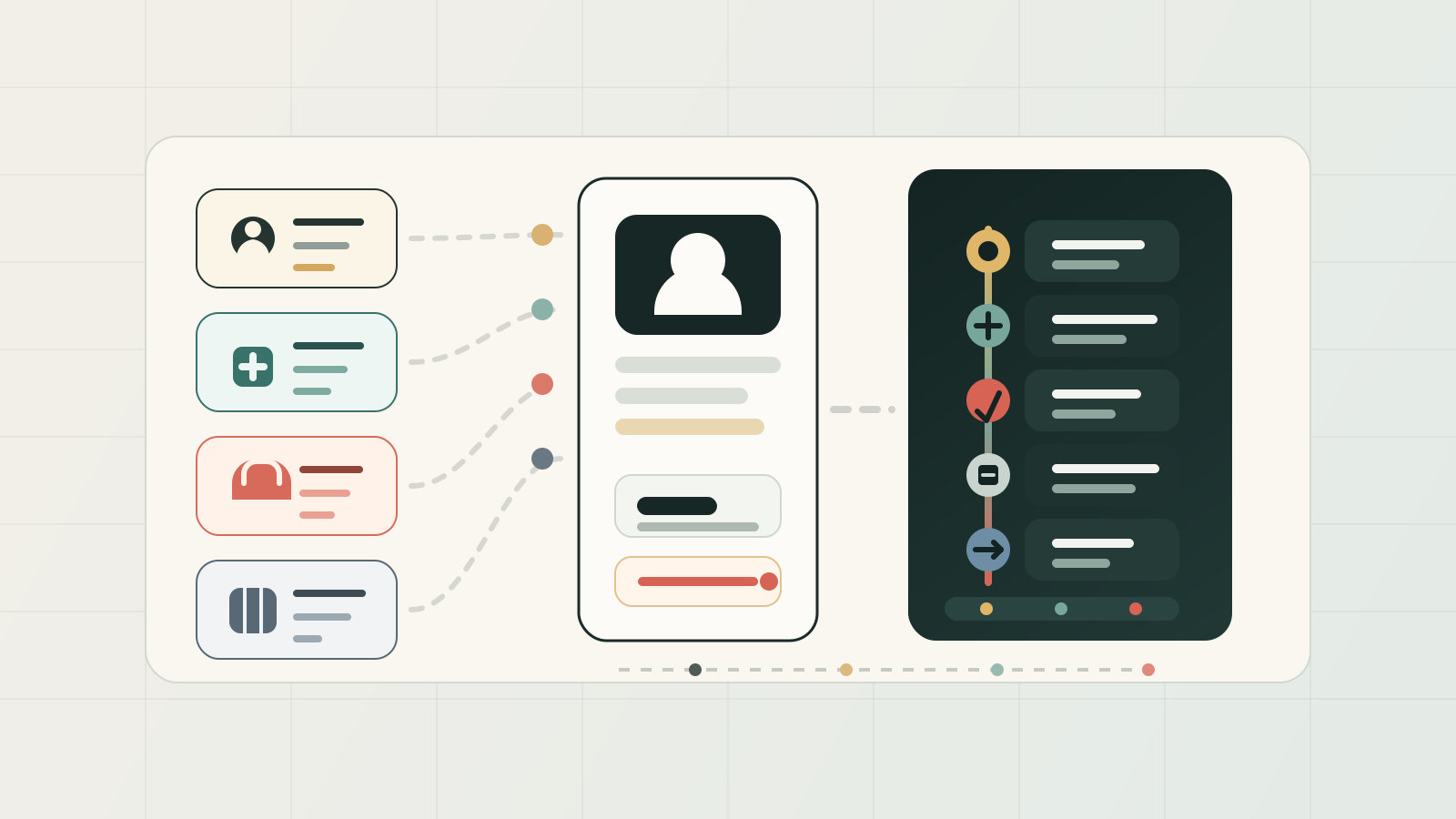
Modern detention management does not need more scattered forms. It needs a shared operational file that follows the detained person from first contact through release or transfer.
That requires at least six capabilities.
1. One detention identity
The event should be created once and keep the same identity across admission, review, custody, resolution, and exit.
2. Continuous chronology
Every relevant action has to remain ordered by time, responsibility, and state of the process. Not as a pile of notes, but as one readable institutional sequence.
3. Property and custody inside the same workflow
Property inventory, receipt, return, and transfer need to live with the detention itself rather than in a separate log that forces the user to leave the operational file.
4. Connected medical and documentary information
Initial review, signed records, attachments, and relevant observations have to travel with the same operational case.
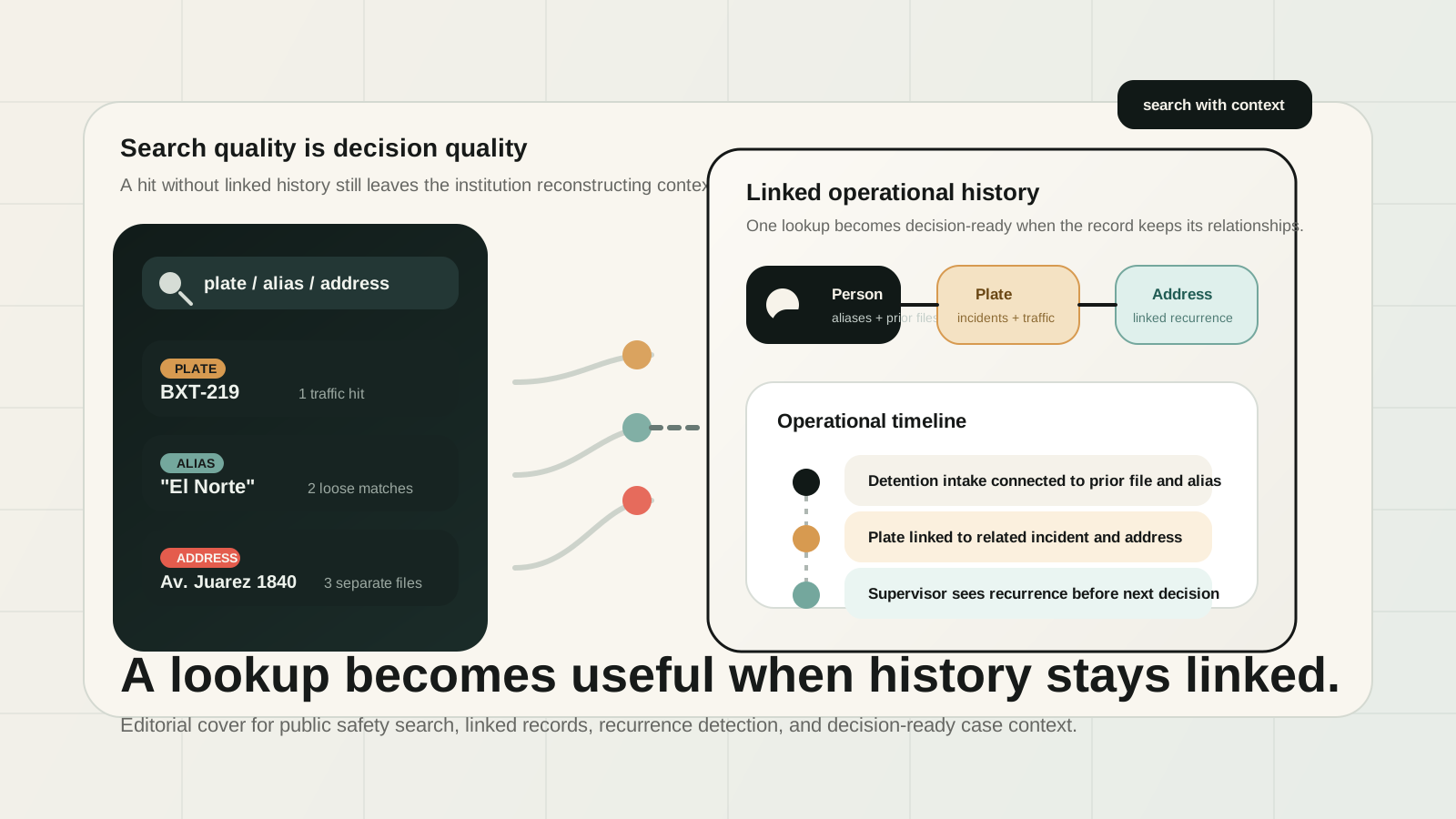
5. Search with context
A useful detention view does not only show who entered custody. It also surfaces history, related events, prior records, and operational signals that improve decision quality.
6. Role-based permissions and auditability
Not every actor should be able to change the same fields. Detention management requires action traceability, a verifiable log, and clear control over who can consult, record, validate, or resolve.
| Isolated booking log | Operational detention file |
|---|---|
| Records admission and exit | Preserves continuity from arrest through release or transfer |
| Each team documents its own fragment | Police, intake, custody, medical staff, and judges share one flow |
| Property and attachments live in parallel records | Property, documents, and observations remain tied to the same file |
| Supervision reconstructs later | Supervision reviews the chronology while custody is still live |
| Search returns disconnected data | Search returns operational context and related history |
The connection to Tribuna is structural, not promotional
Intello's product language already frames the need this way. Tribuna unifies people, detentions, case files, incidents, evidence, vehicles, and rulings on top of a shared data model; supports search with context; strengthens traceability and auditability; and explicitly contemplates police, forensic teams, judges, and detention centers working on the same operational flow.
That matters because institutions do not solve detention management by adding yet another isolated module. They solve it when detention, custody, review, and decision stop circulating through partial records and start operating on a shared institutional truth.
The Torreón Municipal Justice Center case makes the logic concrete. There, Tribuna connects detentions, traffic, and forensics in one auditable flow with 360 search, digital case handling, and data governance. The broader lesson for similar institutions is clear: detention becomes more governable when it stops behaving like a documentary island.
Detention needs a live file
A serious institution cannot be satisfied with proving that someone entered custody. It has to be able to read, supervise, and demonstrate how detention unfolded, who intervened, what changed, what was documented, and how the process closed.
That is the difference between registering and governing.
It is also the point where detention management stops being a booking log and starts becoming infrastructure for civic justice, public safety, and institutional trust. If your institution is evaluating how to bring detention, review, and auditability into one governed flow, you can contact Intello to review the operating model in more detail.